

A bad Power BI hire costs you months before anyone admits it. Reports load slowly, the numbers don’t match finance’s spreadsheet, and nobody outside the analytics team trusts the dashboards. Then you restart the search with nothing usable to show for it.
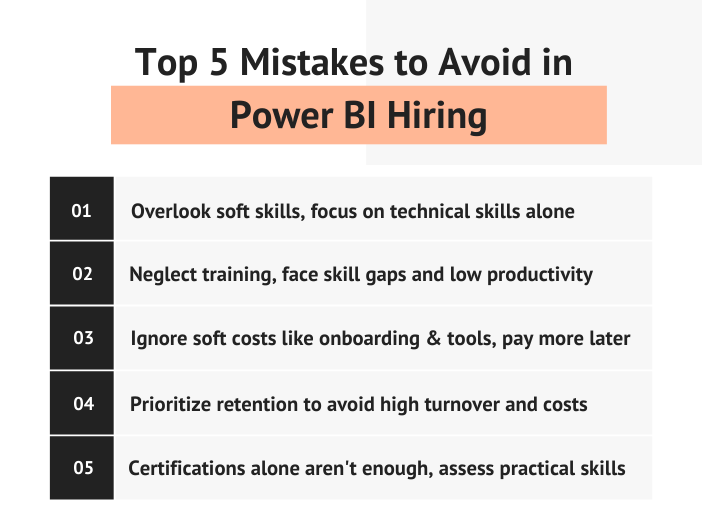
We build Power BI for mid-market teams, and the same five hiring mistakes keep showing up. Below, we cover each one, what a strong hire looks like today, and when a consulting partner is the faster, lower-risk move.
Short answer: Hire for business and data-modeling depth, check governance and Microsoft Fabric experience, and don’t expect one person to cover every skill. If your need is urgent, project-based, or spans several skills, a partner is usually faster and lower risk.
The Power BI hiring mistakes that cost teams months
Mistake 1: Hiring for tool familiarity instead of business and data-modeling depth
Anyone can build a chart. The job is turning how your business measures itself into one set of numbers everyone trusts. Ask candidates how they would handle your sales, inventory, or patient data, and what they do when two systems disagree on a number. Strong answers start with your business, not the software
Mistake 2: Underrating DAX and semantic-model skills
Most broken dashboards fail in one place: the layer of definitions and formulas under every number. DAX is the formula language behind Power BI’s calculations, and the semantic model is where those definitions live. Wrong totals, slow reports, and figures that shift with each filter all trace back to it. Ask candidates to walk you through a formula they wrote and why. If they can’t explain it plainly, the dashboards won’t hold up with real users. Our guide to mastering DAX goes deeper.
Mistake 3: No governance, deployment, or Fabric experience
A dashboard on one person’s laptop is not a BI capability. Once reports reach real users, someone has to control who sees what, how updates move from testing to production, and who owns each dataset. Power BI now sits inside Microsoft Fabric, Microsoft’s wider data platform, so candidates who only know Power BI Desktop will struggle as you scale. Ask how they managed releases and access in their last role.
Mistake 4: Ignoring Copilot fluency
Copilot in Power BI is becoming a baseline skill. It drafts formulas, summarizes reports, and lets business users ask questions in plain language. It works well only on a clean, well-named data model, and it will state wrong answers with confidence. You want someone who knows where Copilot saves time, where a human must check it, and how to prepare data so it answers well.
Mistake 5: Expecting one person to be data engineer, analyst, and designer
Job posts often ask one person to build the data pipeline, write the formulas, design the reports, and act as business analyst. That person rarely exists, and if they do, they are expensive and hard to keep. When one hire covers every job, something gets skipped, usually the pipeline or the design, and the dashboard pays for it.
What good looks like now: a Power BI developer skills checklist
Use this table to screen candidates. If someone is strong in two or three rows and weak in the rest, decide who fills the gaps before you make an offer.
| Skill area | What you should see | Question to ask |
|---|---|---|
| Data modeling and DAX | What you should seeCorrect totals, fast reports, clean models | Question to askWalk me through a formula you wrote and why. |
| Business translation | What you should seeExplains numbers to non-technical leaders | Question to askExplain this KPI as if to our CFO. |
| Governance | What you should seeControlled access, test-to-production releases, clear dataset owners | Question to askWho could see what in your last role? |
| Fabric fluency | What you should seeWorks alongside data engineers on shared data | Question to askHow did you split work with your data engineering team? |
| Copilot fluency | What you should seeUses it, checks it, prepares models for it | Question to askWhere do you not trust Copilot? |
Hire vs. partner: when a consulting partner is faster and lower risk
A Power BI consulting partner is an outside team that supplies modeling, data engineering, and design skills on demand, so you don’t have to hire and keep each one.
A hire costs more than salary. Add recruiter fees, onboarding, training, equipment, and the risk of turnover. Then add time: a proper hiring process takes weeks or months, and pressure to fill the seat is how bad hires happen. A partner removes most of that. If the fit is wrong, you adjust the engagement. If a full-time hire is wrong, you manage an exit.
| Situation | Better fit |
|---|---|
| You need dashboards live in weeks, not quarters | Better fitPartner |
| Your needs are project-based or will change over the next year | Better fitPartner |
| You need data engineering, modeling, and design skills together | Better fitPartner |
| Power BI is a daily, permanent function across the company | Better fitFull-time hire, ideally backed by a partner |
| You have a strong internal lead who needs extra capacity | Better fitPartner, on demand |
How Sunflower Lab delivers Power BI
Sunflower Lab is a US-based Microsoft Solutions Partner with 100+ Power Platform builds delivered. A few Power BI examples:
- OW Logistics: an operations dashboard that gave the team one view of daily logistics.
- General Air Products: business intelligence for a manufacturing and distribution operation
- BCDCOG: reporting for a regional government body.
Our on-demand Power BI team works like this:
- Block-hour packages with the price clear upfront.
- Packages you can move up or down as your needs change.
- One team covering modeling, formulas, Fabric, governance, and design.
Explore our Power BI development services.
FAQ
What skills should I look for when I hire a Power BI developer?
Look for four things: data modeling and DAX, so the numbers are right and fast; governance, so access and releases are controlled; Microsoft Fabric experience; and the ability to explain results to non-technical leaders. Copilot fluency is now part of the baseline. Strength in only two or three means you need a plan for the gaps.
How much does it cost to hire a Power BI developer?
Salary is only part of the cost. Recruiting fees, onboarding, training, equipment, and turnover all add to it, and a slow search adds months of lost reporting. Compare the total cost of ownership with a block-hour package from a partner, which gives you clear upfront pricing for a set number of hours.
Should I hire a Power BI consultant or a full-time employee?
If your need is urgent, project-based, or spans several skill sets, a consultant is usually faster and lower risk. If Power BI is a permanent, daily function across the company, hire full time, and keep a partner available for surge work or skills your hire does not cover.
Can one person handle Power BI from data pipeline to finished report?
Rarely. Data engineering, data modeling, and report design are different skills, and the few people who cover all three are expensive and hard to retain. Most strong Power BI programs use a small team, or one lead backed by a partner, so nothing gets skipped.
Does Copilot replace a Power BI developer?
No. Copilot speeds up drafting formulas, summarizing reports, and answering plain-language questions, but it depends on a well-built data model and human review. Without both, it produces confident answers that can be wrong. A developer who prepares the model and checks the output is what makes Copilot useful.
Not sure whether to hire or partner?
Book a free Power BI assessment. We review your current setup, tell you which skills you need, and show you whether a full-time hire or a partner makes more sense.
Power Up Your Business Intelligence with Power BI
Turn complexity into clarity with our user-friendly Power BI solutions.
You might also like
Stay ahead in tech with Sunflower Lab’s curated blogs, sorted by technology type. From AI to Digital Products, explore cutting-edge developments in our insightful, categorized collection. Dive in and stay informed about the ever-evolving digital landscape with Sunflower Lab.