

AI in healthcare isn’t just hype, AI in healthcare is showing up in everyday practices like yours, helping small to mid-sized teams (100–1000 people) do more with less. We’ve moved past the theoretical. The impact of AI is now tangible, cutting costs, reducing burnout, and giving patients better experiences.
From smarter workflows to happier patients, this shift is no longer optional. Let’s break down how healthcare AI intelligent automation solutions are making life easier for practices just like yours.
A Quick Trip Down Memory Lane
It may seem like an innovative idea when discussing AI in healthcare today. The reality? Although it has been around for decades, it has just lately made its way from labs to regular clinics like yours.
Since the 2000s a massive shift happened: Electronic Health Records (EHRs) become the standard. Suddenly, decades of paper files and charts were digitized. This was the turning point – AI now had data to operate with. During this era, hospitals began experimenting with healthcare AI services in targeted areas like radiography. AI could scan thousands of medical images, flagging anomalies faster than human eyes. On the administrative side, early automation began easing repetitive processes like billing and scheduling.
These weren’t headline-grabbing breakthroughs, but they laid the groundwork. AI was no longer just theory, it was quietly proving it could handle repetitive, data-heavy tasks in healthcare settings.
Post COVID-19 Era
COVID-19 changed the healthcare world overnight. With remote care, telemedicine, and skyrocketing patient demand, clinics needed smarter solutions. The timing aligned perfectly:
- Cloud computing matured– giving practices affordable access to computing power once reserved for research labs.
- Data volumes exploded– wearable devices, patient portals, and digitized labs provided rich input for AI systems.
- AI algorithms advanced– enabling faster, more accurate insights across clinical and administrative workflows.
For practices, this resulted into genuine, practical benefits:
- Admin Relief: A healthcare AI agent might now undertake repetitive work like insurance verification, claims processing, or appointment scheduling. The burden of unending paperwork started to lighten.
- Patient Engagement: Tools like AI chatbots and virtual assistants gave patients 24/7 access to reminders, follow-ups, and answers – making treatment more continuous and personal.
- Clinical Support: AI started playing the function of “clinical co-pilot.” From evaluating images to offering potential diagnoses, it gave clinicians an added layer of intelligence without replacing their knowledge.
In short, AI finally crossed the bridge from being a futuristic concept to a trusted partner in daily healthcare practice. Even smaller clinics, not just mega-hospitals, could now benefit from AI, thanks to affordable cloud-based solutions and packaged healthcare AI services built for their scale.
Amazing Wins for AI in Healthcare
The energy around AI in healthcare has shifted from curiosity to cautious excitement. Not long ago, AI felt like something only the “big guys” could afford, massive hospital systems with equally massive budgets. But that’s changing fast. Today, even mid-sized practices are experimenting with healthcare AI services, and the results are speaking for themselves.
Doctors are warming up. In fact, physician AI use jumped from 38% to 66% in a single year, and nearly 90% of family physicians say they’re willing to try it. This tells us something important: the momentum is no longer being pushed by Silicon Valley, it’s being pulled forward by everyday clinicians who see real value in their day-to-day practice.

The use of AI in healthcare isn’t just about adopting the latest shiny tool. It’s about solving the nagging, costly problems that have frustrated providers for decades. From cutting administrative burdens to boosting revenue and elevating patient satisfaction, healthcare AI services are delivering measurable impact today.
The question for your clinic isn’t whether AI works, it’s how soon you’ll put it to work for you.
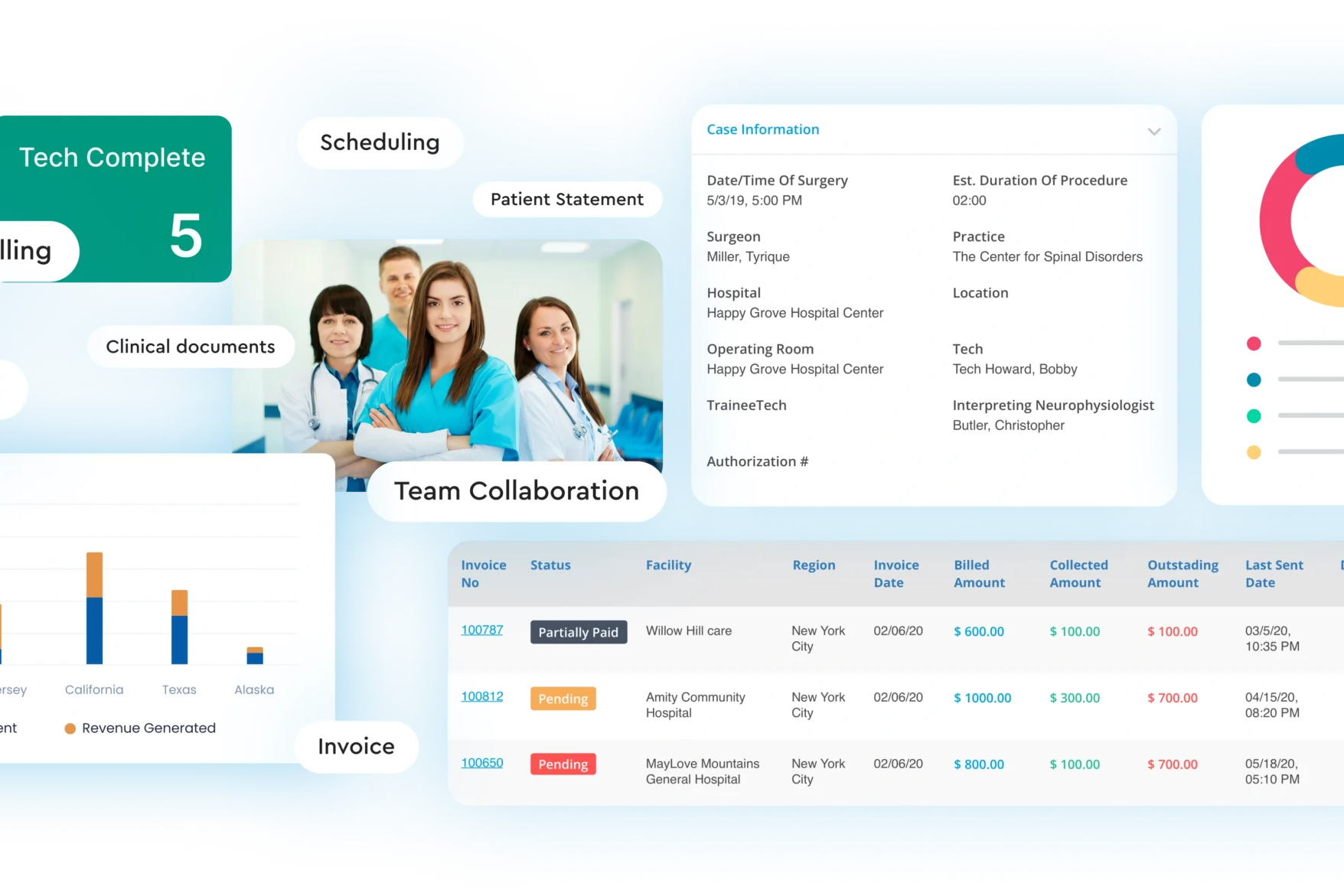
Transforming Healthcare Administration & IONM through Digital Solutions
A SaaS Healthcare Product that Combines Data Analytics with Collaboration
Challenges & Controversies
While the promise of AI in RCM is massive, the path forward isn’t free of turbulence. Leaders weighing adoption are grappling with some very real obstacles:
Cost vs. ROI
Implementing AI frequently asks for improvements in infrastructure, cloud computing, cybersecurity, and employee training; it’s not simply about purchasing software. Small and mid-sized practices may find this upfront expense too much to bear. The opposing viewpoint? Significant efficiency benefits, lower administrative costs, and quicker revenue cycles are all indicators of long-term ROI. Bridging the gap between investment and payoff is the difficult part.
Data Dilemmas
AI programs can only be as intelligent as the data they use to learn. Even the most advanced models can be derailed by inadequate datasets, duplicate patient information, or fragmented EHRs. Healthcare providers must prioritize the development of clean, standardized, and interoperable data pipelines; otherwise, AI runs the danger of exacerbating rather than resolving current inefficiencies.
Privacy Panic
More than 75% of patients are concerned about the storage and sharing of personal data, according to recent surveys. Compliance with HIPAA, GDPR, and changing privacy legislation is essential when it comes to sensitive health records. In addition to following the law, providers need to gain patients’ trust by using transparent, unambiguous data processing procedures. Reputations in the healthcare industry can be destroyed in a single breach.
Job Anxiety
Doctors, nurses, and administrative personnel fear that AI may replace them. The truth is more complex. AI is more effective at augmenting human judgment, which is crucial to patient care, than it is at replacing repetitive, low-value work. However, as employment responsibilities change, providers will need to make investments in new training routes and reskilling.
Trusting the Algorithm
Among the most significant obstacles is explainability. When a diagnosis is flagged by an AI model, doctors frequently wonder why. Trust is damaged if the system is unable to respond. More visible, “glass box” AI that displays reasoning routes rather than just outputs are what regulators, suppliers, and vendors are aiming for. Adoption in critical care will continue to be cautious in the absence of this.
Integration Headaches
Patchwork integrations and older systems are common in healthcare IT ecosystems. Modern AI tools are rarely easy to integrate. Implementation is slowed down by interoperability gaps, vendor lock-in, and compatibility problems. Open APIs, modular solutions, and progressive IT strategies are the answer.
What’s Next for AI in Your Clinic?
If the last decade proved that AI in healthcare can move from concept to reality, the next decade is about scaling accessibility, intelligence, and trust. The horizon looks promising, not just for large hospital networks but also for small and mid-sized practices that want to deliver smarter, more personalized care.

Conclusion
The healthcare landscape is shifting rapidly, and AI in healthcare is no longer a futuristic concept, it’s a practical reality transforming everyday workflows. From automating repetitive back-office tasks to providing clinicians with real-time decision support, AI is proving to be a catalyst for both operational efficiency and better patient care.
For growing practices, the benefits go beyond convenience. AI in RCM can minimize revenue leakages, predictive analytics can flag patient risks before they escalate, and intelligent automation can reduce administrative burden so your team can focus where it matters most on patient relationships. These are not incremental gains; they’re the kind of strategic shifts that can determine whether your clinic leads or lags in the next era of healthcare delivery.
Ready to Level Up Your Practice?
The real question isn’t whether AI agents are coming to healthcare, it’s how your practice will harness it to thrive. Will you use it to empower your staff, improve patient outcomes, and secure financial resilience? Or will you risk being left behind as peers embrace technology to grow smarter, leaner, and more connected?
If you’re ready to explore the right workflows to automate with AI, book an AI Agent Discovery Workshop with us today. Together, we’ll map the opportunities, design tailored AI strategies, and help you build a future-ready practice that grows without burning out your team.
You might also like
Stay ahead in tech with Sunflower Lab’s curated blogs, sorted by technology type. From AI to Digital Products, explore cutting-edge developments in our insightful, categorized collection. Dive in and stay informed about the ever-evolving digital landscape with Sunflower Lab.